 Home
Home
Life is a great big canvas, and you should
throw all the paint on it you can.
Danny Kaye
Day 6: DNA verification and DNA manipulation
Assignments Due
Overview of Experiment
In today's lab, you analyze the PCR reactions for the whole plasmid
PCR on an agarose gel. You also perform a restriction digest
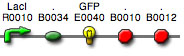
on the whole plasmid PCR of BBa_I13522:
pTetR-GFP to destroy the vector template before performing transformation.
Agarose gel analysis of PCR products
- Prepare a mini 1% agarose gel with one 8-well comb (use
~40 ml molten agarose) as on Day 2 [3 teams will share
one gel]
- Preparation of PCR samples:
a. Spot 1 µl 6X loading buffer (LB) on a piece of parafilm (one spot for each PCR sample)
b. Remove 5 µl from the 1st PCR tube, mix it with one spot of
6X LB by pipetting up and down, and load the sample into a well
c. Repeat procedure for each PCR reaction
- Load
10 µl 1 kb DNA ladder
- Run the gel at 130 V for ~20 min
- Photograph the gel and compare the observed bands to
the standards
- Did you get the expected size products?
DpnI digestion of PCR products
- Divide the remaining PCR sample for the mutated RBS in half
- Add 1 µl
DpnI (NEB
Catalog #R0176S) to one of the PCR samples
- Incubate both PCR samples at 37°C for 1 hour
- Inactivate at 80°C
for 20 min.
- Store samples at -20°C
Copyright, Acknowledgements,
and Intended Use
Created by B. Beason (bbeason@rice.edu),
Rice University, 21 November 2007
Updated 6 November 2013